
How the Internet Became Commercial
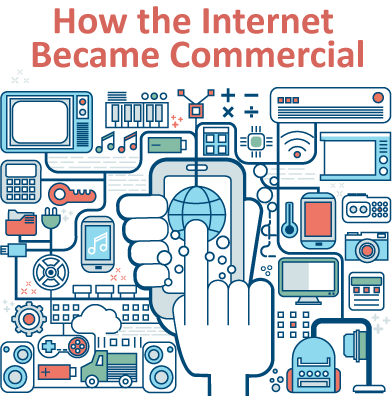
What’s Behind the Commercial movement of the Internet? Believe it or not the Internet was not originally created to share your life on social media sites like Facebook and Instagram or to watch movies, play games or follow your favorite pastime. When it was first invented, the military and research universities were the primary users of the Internet, via several loosely connected networks. However, over time, and at a rather rapid pace, the Internet has become the commercial powerhouse it is today. That wasn’t always the plan or the goal for the Internet, so how did it become the mainstream commercialization machine that it is today?
Patterns in the Deployment of Technology
I spoke with Shane Greenstein, who is a faculty member at the Harvard School of Business, about this topic, which also happens to be the subject of his book How the Internet Became Commercial. Shane is the MBA Class of 1957 Professor of Business Administration and co-chair of the HBS Digital Initiative. He teaches in the Technology, Operations and Management Unit. Shane is also co-director of the program on the economics of digitization at The National Bureau of Economic Research. When I spoke with Shane, I noted that now that we’re moving into the realm of big data, understanding human behavior aspect of it. So I asked: “When we look at this today are there patterns that are emerging?
Repetition and Coordination
“The interesting thing is that an awful lot of what we observe today are patterns that we have seen in the past. And the more you appreciate how much repetition there is the easier it is to identify. For example, when very big things deploy you tend to find patterns of hesitance because multiple firms have to cooperate together in order to make something work as a system. Getting that coordination to work is usually quite difficult. That’s something you saw in electricity and automobiles, airplanes the Internet and we are seeing today in big data. Disagreements about fields, disagreements about getting the coordination of different ways and algorithms to get them to work with each and have standardized ways of doing machine learning so that everybody can talk to each other.”
Adaptation Problems
Shane also noted, “The other thing you typically see when big things deploy is adaptation problems. It turns out big technology isn’t useful out of the box. It requires much more investment to adapt to the needs of a particular user and that kind of adaptation is fairly expensive typically. It’s typically where most of society spends most of its money as it turns out. Again you saw it in electricity, you saw the pattern in automobiles and you see it in every major deployment. And again you saw it in the Internet and if you look at big data what’s the big problem? You see it everywhere: adaptation. Lots of firms have the data but they haven’t figured out exactly how to modify it in order to find the value in it.”
To view the full interview with Shane please click here.
Legacy Builders Philanthropic Revolution
Legacy Builders Conference Inspires Philanthropic Revolution The recent “Legacy Builders” event has sparked a philanthropic revolution, inspiring attendees to leverage their accumulated wealth for world betterment. The event, held on May 15, 2024, in San Jose, CA, featured distinguished speakers including NFL legend and HGGC Partner Steve Young¹, retired three-star General Michael Barbero², and Becky…

Transform Your Life Every Morning, Hal Elrod
Hal Elrod, an international keynote speaker and best selling author of 12 books, including “The Miracle Morning“—which has been translated into 42 languages discusses how to transform your life a little every morning on Alan Olsen‘s American Dreams Show. Transcript: Alan Olsen Welcome to American Dreams. My guest today is Hal Elrod. Hal welcome to today’s show. …

Rob Ryan’s Amazing Movie Premiere June 28th on How He Saved the Internet
The Hollywood movie premiere of the Rob Ryan story is a cinematic tribute to innovation. This remarkable film documents the real-life journey of this visionary from crisis to triumph and how he saved the internet! On June 28th at 9:30 PM in the iconic TCL Chinese Theatre. For tickets, click here. Rob Ryan, Founder…

Early Detection Saves Lives with Steve Marler
Steve Marler, Founder of Advanced Longevity discusses how early detection can save lives and overcoming a broken healthcare system on Alan Olsen‘s American Dreams Show. Transcript: Alan Olsen Welcome to American Dreams. My guest today is Steve Marler. Steve, welcome to the show. Steve Marler Thank you. It’s great to be here. Alan Olsen So Steve,…